Shepp
-
Posts
29 -
Joined
-
Last visited
-
Days Won
26
Everything posted by Shepp
-
Hey Gang, Johnny here. Guess what? I've got a new album out called Marcato, just released this past weekend. More to come including some videos. Will keep you posted, enjoy https://johnnyshepp.hearnow.com/
-
A little diversion, but I'm quite pleased with this cover I did of Jimi Hendrix Experience's Fire https://youtu.be/v2EVWrrbmFE
-
Thanks very much, I'm glad you're enjoying the tracks. I never did pursue getting the material ready for live as I was quite busy playing out with my studio partner's band and producing, doing live sound and all the other stuff. I would have been fun to do however, it would have likely been a four piece group.
-
Ok Daniel, here we go... you may need to re read this a few times to get the gyst. I'm going to describe not only the tunings, but also the the arrangements in terms of tracks. The best advice I have in terms of learning these guitars is to first be familiar with the CAGE chord shapes in standard, as these alter quite a bit when you play in open tuning. Most of the songs from the Mixed Emotions era, ie, 1999-2002 were written with open tunings on the acoustic guitars, blended with standard tuned electrics on top. Lover's Canyon, Torture, and Essential Truth are standard tunings, however in Essential Truth you'll hear a capo'd 12 String doubled over the final Choruses; (Most 12 Strings that are older are never tuned to standard EADGBE, but a whole step down to DGCFAD because the neck would warp over time from the higher tension) and that was the case here. Been Down's tuning on the acoustics was DADFAD in order to get the minor/major stress points out. I believe the electrics were just Drop D, as in DADGBE. This allowed the deviations you hear occassionally on the E chords from minor to major dominant (a blue note) in the altered chorus. But of course I chop up the progression to keep it more interesting during the piece. The fingerings are quite a challenge. The electrics were a Dean Cadillac through the Marshall using the neck pickup. Nevermind's acoustics were tuned to EAEABE (keep in mind that using this tuning puts stress on the D string as it's up tuned to E) This tuning has a minor 6 flavour to it. It starts like a celtic drone with the Hammond B3 blended in throughout. The Electrics were all a 1963 Telecaster through a Fender Blues Deluxe. Torture is in Standard, quite a lot of modal movement in that one. One Acoustic, hand drums and shakers, Wurlitzer, two Strat tracks, one with a Fuzz pedal on it. Because of the repetious nature of the progression, there are some later jazzy aspects on the Wurly. Lover's Canyon has a very common progression in the Verse/Chorus sections, but the bridge has a E major 7, to E minor 7 flat 5, to A7 modal section which changes the feel to push the final chorus section. I used a 1980's Stratocaster through the Marshall for all of the guitars, and an Ernie Ball Wah on the solo guitar. Enchanted is a drop C tuning CGCGCD. That's why the main riff melody has a celtic sound to it. The electrics are in standard, Stratocaster through a Marshall with a Maxon tube screamer in between. The main rhythm guitar is a Telecaster as is the delay guitar, using the Roland 555 tape echo liberally. Then wurlitzer and a Roland MKS for synth bits. I even added a touch of tambourine. Lies uses that same tuning as described previously in Nevermind. The acoustics are doubled around a finger style single acoustic, with two tele tracks with special effects on one, delay and pitch bend from an H3500, printed to tape. Feeling's tuning is DADGBD, and the opening line is accomplished by using an octave on the 2nd and 5 strings on top of the open wash of the others. There are two heavy telecaster through Marshall guitars, likely using Boss Orange Distortion pedal, and the double stops are doubled on a third track. All of these guitars are standard tuned. Then a 12 string stratocaster enters in the prechoruses. This is standard as well with lighter overdrive. Hoping this illuminates the obviate :)
-
More snips from my schedule at Utopia Parkway, kind of shows what chaos I was living in, writing and recording in the gaps ======================================================================= 1/2/00 Jerry Nickel 1/3/00 Jax and John 1/4/00 Jax and Jeff 1/5/00 Stuff To Do 1/5/00 Jax and Jeff 1/6/00 Re:MGB 1/6/00 Jeff 1/7/00 Quagmire 1/8/00 Jax and Jeff 1/9/00 Jax and Jeff 1/10/00 Tech. 1/10/00 Jeff 1/11/00 Saturnhead 1/11/00 Sales Call 1/12/00 Saturnhead 1/13/00 Jeff 1/14/00 Bocephus King 1/15/00 Jax and Jeff 1/16/00 Jason Michas 1/17/00 Jason Michas 1/18/00 Mimosa 1/19/00 Sales Call 1/19/00 Saturnhead 1/20/00 Quagmire 1/21/00 Call Terry 1/21/00 Jax and Jeff 1/22/00 Steve Dawson 1/23/00 Jeff 1/23/00 Don Clark 1/24/00 Jeff & Tony 1/24/00 Meet Mark Hensley @ Airwaves 1/25/00 Jeff & Tony 1/26/00 Jeff & Tony 1/27/00 Terry Jacks 1/28/00 Jeff & Tony 1/29/00 Quagmire 1/30/00 Quagmire 2/1/00 Terry Jacks 2/2/00 Terry Jacks 2/3/00 Quagmire 2/4/00 Quagmire =========================================================================
-
First I would like to thank you Daniel for your detailed interest in my music, it shows you have a keen ear for details and layers, which is what I endevour to do when writing and arranging my songs, and those of my clients. There are several tricks of the trade that you have uncovered. Similar to artists like Jeff Buckley, I've always been quite eclectic in my tastes. The vast survey of music that informs how I approach arranging music becomes evendent in the layers of these songs. As a kid my first two major interests where in Jimi Hendrix and Led Zeppelin. My sisters bought a lot of records, went through their Beatles phase, and brought home Zeppelin III, on which I feasted. Then there was my parents jazz and classical collections, and oceans more... I first started recording when I was about 12, using two cassette machines to overdub back and forth until I had all the elements down. I already played drums, guitar, and bass, but my guitar was a classical, which I replaced the nylon strings with steel electric guitar strings, threw a microphone in the hole, and plugged into a clock radio I'd ripped apart in order to get that distorted tone I was after-I wanted it all to sound like Foxey Lady. Then came my high school friends, who I would jam with, record everything, and use their amps and electric guitars to learn on. By 15 I was learning all the Rush songs on Moving Pictures, drums, bass and guitar. I just accelerated from there. I have thousands of hours of tape from that era. At 17 I got my first 4 track, and Shepp Studios was born, with all my friends recording our songs, one of which I put on Youtube entitled "Absence Of Compassion". 1994 was the year I first heard Grace by Jeff Buckley, brought by the Studio by Rob Wilson, who I was producing. It was the next major spring board and so inspiring, but during those very densely packed years of producing records, I did not have the opportunity to write and record until about 1999, and that's when most of Mixed Emotions poured out. Here's a snippet of my schedule when I was working on it ======================================================== 11/2/99 Green Room 11/3/99 Green Room 11/4/99 Lavish Mix 11/5/99 Jax 11/6/99 Jax 11/6/99 Jeff 11/7/99 Thomas 11/8/99 Bocephus King 11/9/99 Bocephus King 11/10/99 Bocephus King 11/11/99 Bocephus King 11/12/99 Marq DeSousa 11/12/99 Transvestimentals @ The Brickyard 11/13/99 iMac $110.37 11/13/99 Quagmire 11/14/99 Automatic Slim 11/15/99 To Do's 11/15/99 Quagmire 11/16/99 Jeff 11/17/99 Jeff 11/17/99 Solarbaby @ Roxy 11/18/99 Peggy from SRO 11/18/99 Jax 11/19/99 Shirley Meeting 11/19/99 Jeff 11/19/99 Automatic Slim 11/20/99 Quagmire 11/21/99 Darren Staten 11/22/99 Zubot and Dawson 11/23/99 Zubot and Dawson ========================================================= (I was using the name "Quagmire" then, later I changed it to "Quagmyre", but then to my chagrin, another band started using Quagmyre, so I decided to release under my own name Johnny Shepp.) As you can see, just in November of 1999 there was very little time available, so I would slave away, starting at 10am and working until 3 or 4am. Nevermind, then Feeling, then Enchanted, then Lover's Canyon, and a few others where under development. The approach was usually a guitar and voice demo to click, to which I would slowly overdub the other elements. Vocals, there were several passes done, and I would always take home a cassette copy to tear apart. The lyrics would evolve from there. Some would undergo surgery, others, like Feeling, where stream of consciousness, just delivered vocally. Since I was wearing all the hats: Artist, Producer, Engineer, Musicians, I was super hard on all of them, but I know what trying to achieve perfection will get you-bland. So I always made sure that what ever I did gave me the chills, rather than the chringes. But Nevermind and Lover's Canyon I was never happy with then. I felt they were all deeply flawed. But listening to then now, that many years later, I realize their collective merits. Now to answer your questions: 1. With the space between the recording of each song, would I be right to assume that you just wrote/recorded all of these when you had free time in between recording other bands/musicians at Utopia Parkway Studios? A: Yes 2. I mentioned that Been Down, Lover's Canyon, Essential Truth, and I Never Missed You were favorites of mine. Do you mind sharing the story behind these songs and what inspired you to write them? A: Been Down is a spiritual song, and I did relay my dedication of the song to Ray Garraway, a dear friend who sadly passed away in 2013. He loved this song. I think because of the groove, the bassline, and the way it releases at the end, he had a huge grin on his face when he heard it. Back To You, Back To You, it's a mantra. Lover's Canyon and I Never Missed You, which I wrote the former in 2007 long after Utopia closed it's doors, are both relationships gone bad songs, quite universal. Essential truth is about a dear friend's struggle with schizophrenia. 3. You mentioned some influences yourself on your BC page. Would you include Zeppelin in there too? For some reason I thought of them a little when listening to Never Missed You (though that may just be my own subjective interpretation). A: As I stated above, always Zeppelin, Bonham, Plant, Page, Jones, all of their shades are in me. You can hear it especially in the song Disdain, but I think it cool you hear it in I Never Missed You, perhaps the acoustic guitars and capo'd acoustics are similar to Page. The little melody lines in the chorus. Yes. 4. With regards to your vocal styles, as was noted early, you certainly do seem to know how to utilize different ones. I find that's pretty rare for artists. most of the time a vocalist only has one (or maybe two) and sticks with it through their career. In these songs though you seem to easily more back and forth between more than a few different ones depending on the genre and mood of the song. Was that intentional on your part or just kind of an unconscious adaptation you naturally did? A: Always intentional yes. Like I stated above, I can't stick to a genre to save my soul, ecclectic. Just listen to Peace Bomb, and you hear to electronic side of me. The voice is an amazingly versitile instrument, but most artists stay within a style because our marketplace is ruled by strata councils of genres. I refuse to do that. Even on LOTGA we weren't intirely sure what we were, but it was Rock, and that's all we needed then. Now, it's alphabet soup of genres. More questions please if you please. JS
-
I've launched a bandcamp site and intend on issuing a few more releases The first one is up here: https://johnnyshepp.bandcamp.com/releases
-
Thanks so much guys, appreciate the props. The full channel is here if the URL doesn't get munged. https://www.youtube.com/channel/UCVMEJhvzoWvBeU2xncd2raw
-
Thankyou all for your kindness and interest earlier this year on the records and demos I worked on with MG/B. It was something I'd intended to do long before this year, but fitting as there is still a lot of interest in the period leading up to and including 1995. I hope the pain of this current crisis diminishes and we can once again attend or play live concerts and see our favorite artists. It's been a game changer for my industry and I've seen many of my contemporaries suffer greatly from depression, lack of work, lack of social contact and despair. It's not unlike being in the middle of an album production, in that you can see the light on the horizon, it's just constantly obscured and unclear as to whether a resolution is imminent, or the outcome is a disaster. We can support each other in this by keeping our eyes on the target, we will get there by remaining kind in spirit, and valuing each other. All the best to you all! JS
-
Actually, Matt and I were always goofing around talking in Monty Python voices, and called the multitrack recorders "the big machine that goes "bing"". Probably shows you the atmosphere we had together was generally light hearted. No doubt we kept some of that stuff in just for fun, or it was such a rush job, I didn't mute it out on mixdown. The Depeche song was totally appropriate for that line up to do, I agree, it fit in with the overall sound they had perfectly, and I dedicated a whole session to mixing the final. I was starting another project the next day and another band was in the studio space rehearsing, so I was in the control room working away under a deadline, as Matt and company where on they're final tour (as it turned out). The Producer for the other band kept coming in to listen as I tweaked the mix and he was really digging it. Again it's unfortunate all I can do is describe it, but that will have to do. My best recollection is the first time I encountered Dave Genn was at the Charlie session. Audra had been fired as manager at that point and Frank Weipert had taken the reins. At that point he was managing Big Naked, Art Bergmann, Ronnie Hawkins (Lowest Of The Low) and others. Dave was versitile and playing in Art's band and several recording acts at that time, so he was a bit more experienced. Perhaps part of it was to have him oversee was we were up to. At any rate his contributions were stellar and he filled out was then a new band at the core. I know Frank and I had many dealings after that point as he steered a lot of other acts my way. Dave and I later worked on "Hey Valerie" by Ron Hawkins, a solo EP.
-
Thanks Daniel, I quite enjoyed the talk with Ian and you and the stuff that came up. So with regards to the overall vibe of songs like "Awkward", it really does bare no musical comparison to AMR except being edgy and different. Lyrically and musically there no similarities. The Depeche cover is very close to the original in approach, notably faster though and without layered vocals. The Piano and Cello and Guitar overdubs create the spacious elements, especially in the tag, building up to a crescendo. There is a breakdown before the tag where Ariel does a cool tapping bass arpeggio and then the others slowly build the section more and more. A very inventive version. The lead guitar is a total hybrid, 1980's style sound with distortion and H3500 flanging and delays, to make it stand out. As with most of Matt's solos, they are chiefly there to add melodic support, like the ones you referenced in Radio Bomb. I can't recall when I orginally heard Change Of Season, likely it was in preproduction or during a break at the studio. We never did anything with it. Perhaps because we already had enough material, or that is wasn't yet fully developed.
-
Hi Adam, I'm glad this whole topic has been well received by the fans of MGB. The great thing about the interview was the stuff that was uncovered that perhaps had forgotten. I think given the timeline, the new line up (power trio or with Dave Genn) had a good period of time to gel and define a style. At first the reference points rhythmically were far from the more progressive folk of the previous incarnation of the band, throwing a lot more Police and Pixies into the mix. With Dave in there, this was glued. So the song titles in the vault are as follows: Last of the Ghetto Astronauts: 1. Revenge (very radio friendly uptempo track with Charlie on the drums) 2. Not What You wanted (slacker anthem, laid back and loose) 3. Leaving On A Hijack Jet Plane (Similar to Radio Bomb, a lot of humor and silliness, great drum groove, definitely a b-side) 4. If The Desert Was The Ocean (another downtempo song, the lyrics start with the line "Dolphins don't go the Heaven, they're not allowed") 5. Endless Slow Poison (Total Power trio rocker, sounds like the offspring of Alabama Motel Room and Haven't Slept In Years) No Dave on this one, just loads of guitars. ====================== The Lost Album: 1. Black Penny (Very dark and brooding, progressive song about Social Inequity, dense lyrics) 2. Awkward (the heaviest song on the record, some Alabama in there as well, but the bridge becomes a platform for Steve Codlings piano) 3. The Navigator (Amazing lyrical folk pop song, loads of cello, was intended to lead in to Joe's in Trouble from Euphony reused. We even had a seperate multitrack reel to do this) 4. Ceiling Song (Tongue in cheek song about the thoughts of a "Sunday bored little kid" with a Chorus that's just "Yeah Yeah Yeah" Given the way alot of Milenial music uses this type of hook, it was way ahead of it's time) 5. Wherever We May Go (Change of Season, Apparitions, Symbolistic, etc. Total power ballad) 6. Twelve Second Tour (Similar to Black Penny, heavy, progressive, lyrically dense) 7. Never Let Me Down Again (Depeche Mode cover, big guitar solo section at the end) 8. Healers and Saints (Dylanesque guitar and vocal, lovely lyrics and sentiment Those are the studio recordings/masters that I retain that fall outside of the releases. I don't recall any recordings of any live dates the band did, in effect I was present at only a few shows as it was, including the Gate (Underdogs), Town Pump and Gastown Music Hall.That said, I know that when I was playing at local venues with my bands, we would always try to record the show, but that question would be better put to any members of the tour production crew the band used, rather than me. I think it likely they would be recordings. ========================= The Ghetto release does have several incantations. That's because at first it was an indie release distributed by Outside Music. Yes there were two version, or rather three, as the first had a misprint of the work Ghetto as Ghello. That release was having challenges in retail, because of the MGB title, so fans would ask for Matthew Good Band, but staff would not locate it. So, the full band name became the rejig you see on the second release, still under Outside. Eventually, the title would migrate through to A&M and UMG though I'm not sure when. When Raygun was released, it was intended for marketing in the US, but Private Music/Windham Hill ceased to exist, so it got absorbed into the Darktown label, which was the company Simkin and Co. set up to administer all aspects of the MGB and MG business, so Darktown is an indie label distributed at that point. I only have the cardboard version with the swirly grey CD art. Try not confuse EMI publishing with EMI the Record label, they are different entities. The result of all these versions is really a sign of the mergers that occurred during the 1990's and has resulted in some unique and different CD's. E&OE
-
You're welcome, Millstone, yes I would tend to agree, but you never know, with age sometimes you get sentimental. Yes, it was recorded on linear digital tape. The studio had a good compliment of decent tube preamps, and the console was english (an Allen and Heath with VCA automation)
-
Yes I do have the full digital master of Euphony. At this point it is in the vault. If there was a desire to release it digitally, that process could be done. The 15 hours material I am unaware of any digital media that was kept. It may have just been a cassette, given we were using the studio as part of an award. I know the Sony DASH tapes were provided free of charge and likely reused later by students. It was a studio used by either Trebas or Columbia Academy at the time. It's likely my assistants on that session were all students as well.
-
Very sad news. RIP Rich Rock
-
Hi Steve, Yes I've stayed in touch with all the previous band members, as well as Dave and Ian. Stay tuned, there's an interview video that Ian and I participated in with Daniel that should answer a few more questions and reflects upon our work all those years ago.
-
Daniel, here's the sequence I came up with for the "Lost Album" 1.Black Penny 2.Awkward 3.The Navigator 4.Ceiling Song 5.Wherever We May Go 6.Twelve Second Tour 7.Never Let Me Down Again 8.Healers And Saints Songs never completed or just demoed and we didn't come back to: -The Boy Who Cried Wolf (not recorded) -A Mile Out Of Paris (single mic recording to document, never produced) -I Dream Of Dolphins (produced, stripped down, vocals, guitar, piano and bass, abandoned) -Sky Pilot (perhaps a title, but never recorded) The general impression of the eight competed songs is like 15 hours, but fully realized and edited. Out of the eight, all are strong compositions, the first two lyrically dark subjects of disharmony, bias, racial injustice, social reform, etc. The Navigator also has a heavy feel to it, a bad relationship song. Then Ceiling song, light and airy, about a bored kid staring at the cieling making up imaginary subjects. 12 Second tour is most Dylanesque tale of what battles of the mind occur to one standing on top of a 40 foot building thinking of jumping (very progressive beats by the rhythm section, lots of trademark vocal heights) Wherever We May Go (Big ballad, like Apparitions, big strings and piano) Never Let Me Down Again - A playful cover of the Depeche Mode song. Matt kicked this vocal out of the park. Healers and Saints, folky guitar and voice, ends with the opening line from Symbolistic White Walls. The sad part perhaps is it sits in the vault, but ultimately, when March of 1995 came along, the band was done, and a whole new scene will new songs emerged, and as they say, the rest is history and counterpoint. You don't know until you know, and when EMI wanted to release, well you just go along and do your best. There was something about the momentum of the first session with ace drummer Charlie Quintana, and songs themselves were more mature and honed than before (most of them). The "Tug Of War" was over, especially near the end when the big guns came out. We never looked back.
-
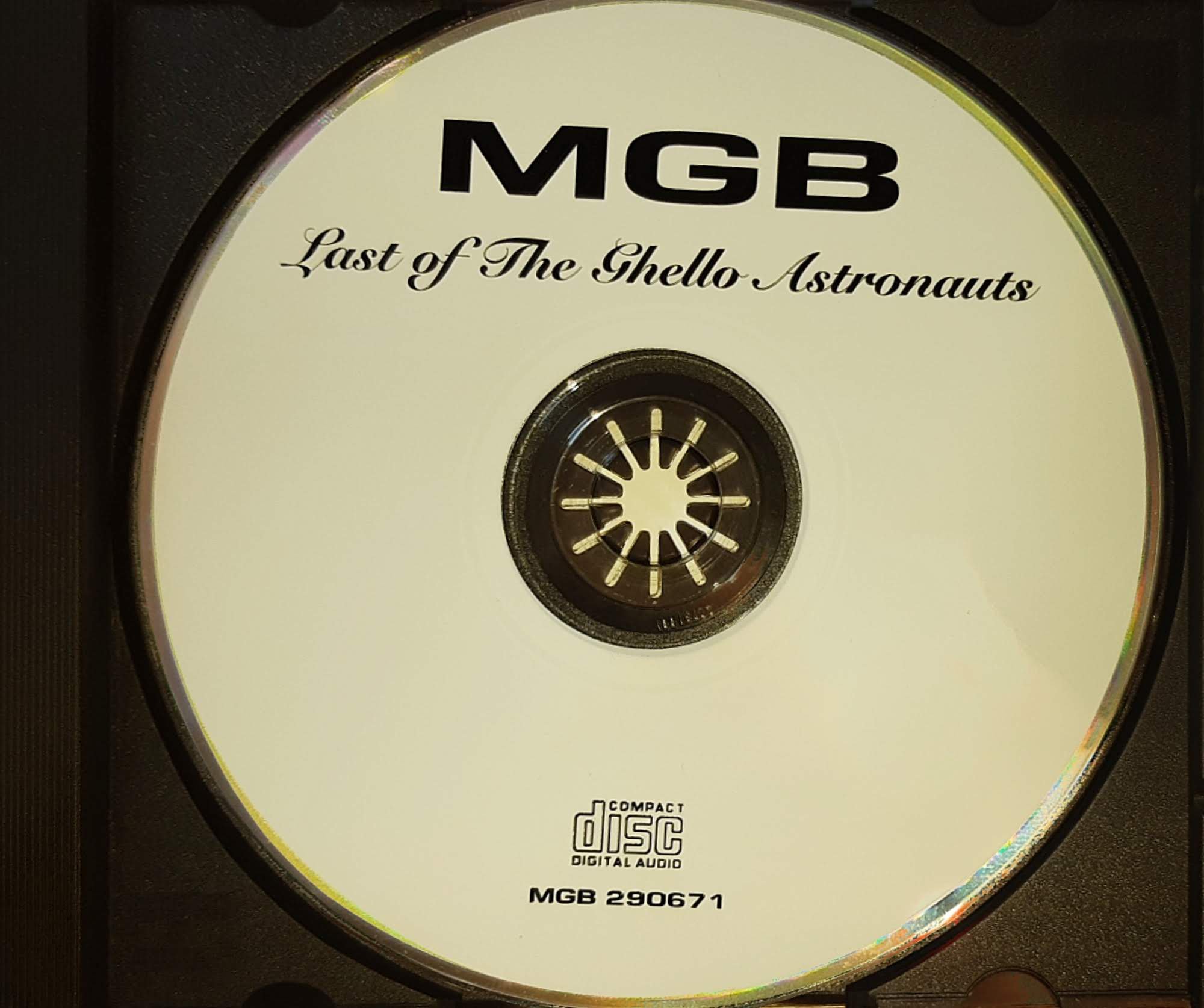
The first run of CD's had the well known misprint of the word Ghetto as Ghello, but did you know it also had Matt's birthday, MGB290671? That's today, so happy 49th birthday Matt!

-
I think once people discovered how good the lyrics were in Omissions, they latched on to it. It is superior writing. Ian Tyson wrote Four Strongs winds at 24, Matt wrote Omissons at 24. Ok, there were at least two different sequences to LOTGA, neither included Revenge, which was the Charlie session I mentioned above. The third version is the one you all know with Omissions at the end as a hidden track, but here's order number 2, which includes all the songs we recorded during that period after Revenge was done. You'll notice some interesting similarities. 1. Alabama Motel Room 2. Symbolistic White Walls 3. She's Got A New Disguise 4. Native Son (except the organ doesn't fade at the end, it continues and resolves from a sus4 to major, very churchy, a definite attempt at humor by Dave as I always noticed how he avoided 3rds constantly to make the chords float unresolved) 5. Vermillion 6. Fearless 7. Omissions Of The Omen 8. Haven't Slept In Years 9. Radio Bomb 10. Not What You Wanted 11. Leaving On A Hijacked Jet Plane 12. If The Desert Was The Ocean 13. Endless Slow Poison 14. The War Is Over 15. Every Name Is My Name Total running time 1:08:38 Since the limit for CD format was 74 minutes, we could have had Every Name Is My Name as a hidden track in this sequence.
-
You're right, in fact, it would have had sense to have it as track 11, just after the tail end of The War Is Over. In 1995, hidden tracks were a niche thing, as most people would listen to the album or several in a CD changer system. The hidden track would appear only if the changer system didn't time out, otherwise, it would continue to the next programmed CD. Omissions did become popular though, I would hear about it all the time. Sad to see it didn't get included on the vinyl album as side four. But to cut a metal master for one song, or to thin out the grooves to include it on side three would have been a production decision of compromise. I think we did three different sequences of LOTGA, I'll have to dig the masters up (pretty sure I still have them) and post the original orders (like in the video for the Lost Album), they evolved to shorter and shorter versions.
-
Hi Tips, "I Dream of Dolphins All The Time" is a line from the song "I Dream of Dolphins" and reused in the song "Sharks Of Downtown" Borrowing from other compositions (because the line is so good, why not use it again?) is also seen on the song "Healers and Saints" recorded just after Dolphins. In that, the line "I'm tired of blood and overpriced bubblegum, Mom" ends the song. Six months later, it reappears, to open "Symbolistic White Walls" Great line to recycle, as Healers was never even mixed. It was just a takeaway tape for Matt to take home. No newer versions of Dancing Invisible were done, it was just a subject when we were doing Lost Album material about whether in an album release we would retool the drums and bass with the newer members. When you stop to think of how LOTGA is genuinely more like a Coppola film, drawn from everywhere, it's amazing at the end, the almost perfect sequence was found, and the right songs chosen. I credit that to Mike McCarty of EMI. The only regret was were Omissions was placed. I previous sequences Matt and I had done, it was dead center of the record, like an intermission with Omissions.
-
Hi Daniel, My memory is time period of time between Euphony and doing the 15 Hours session is vague. I don't see any rehearsal dates that I was present on, and likely not, because the band had already been in recording studios, and knew the process. 15 Hours was free recording time, won as the result of the CFOX contest. (I don't recall if I got paid much, doesn't matter in the long run anyway). Fact is, I was up for it, and to capture new material was the best use of the time. I don't recall getting stuck on the arrangement flaws, which were plenty, and rather just resolving to showcase the best parts in the mix, like when you're mixing a concert. The songs are quite epic lyrically and otherwise. When we finally did reconvene the following January, there was new group of songs that were better than those, but similar in approach. All the 15 Hours material got left behind in favor of what was new. Let me be clear, these were ALL group efforts, meaning every member wrote their own parts, and Matt would likely curate them, and lead the band like any band leader. He was clearly the driving force behind it all. That said, when it comes to songwriting credits, in the pure sense of copyright, lyrics and melody are all the matter. Music "arrangements" are generally collaborative in bands (sometimes this becomes and battle of wills, sometimes it's logical and easily obtained). The Producer's role is to keep the peace, but have final say. I don't have any favorites, it was just really cool to hear them after all this time. Sounded better than I remember to be honest.
-
Hey Tips no sweat, happy to say my say! The transition was not gradual at all. We had just finished mixing the Lost Album (actually I did most of it while the original lineup was on tour) then, boom, one phone call later, I was at Matt's apartment meeting Geoff Lloyd. I believe I didn't meet Ian that day but could be wrong. I believe Geoff relates this story in the memorial thread, about him being at Undertones and getting the call. At any rate the only orginal member on the newer material at that point would be Judy. LOTGA proper started in March of 1995, with the Charlie Quintana session, at which Charlie laid the song Revenge down, then a tambourine track, then Ian stepped in a delivered Fearless and Vermillion. Dave was there throughout and we cut some organ tracks on Vermillion and Revenge, the follow sessions were to overdub Steve Black's Piano on Fearless, Judy's cello, and Ian did the background vocals. Dave was a hired gun at first, but he was fully into it. and was really a big reason this album had legs, he added so much glue to the arrangements. Funny memory comes up. He'd always have to haul the organ rig from the Town Pump where it was stored and we'd hump it in. After hours of tooling re tooling the tracks we'd haul it all back into the van at 3am or some ungodly hour. He'd always say "Don't dont call me to come back and fix anything!" So essentially, when it became Ian, Geoff and Dave, we quickly forgot about the previous Lost Album material. Everything you hear occurred after the Charlie session, and ultimately, Charlie's contributions were forgotten too as Revenge was not in the final lineup. There we at the end three different sequences to what became LOTGA, at first it was something like 15 songs but it was eventually culled down to the final order you hear. Raygun happened likely out of a need to expose MGB to the US market, but there's been plenty said about the Private deal already, I have nothing to add there. When you look at the albums that MGB did after, well, Dave and Matt were collaberating then. But on LOTGA, the only co-write is Alabama Motel Room (Good, Lloyd,Browne) So still confusion about the band lineup? Euphony had Danny and Joe 15 hours and the Lost album had Ariel and Erin LOTGA had Geoff and Ian Judy was on all three The was a marked difference in the material on Lost, way more folk, way more lyrics. More Talk Talk than Pixies, and LOTGA had a blend between the two.
-
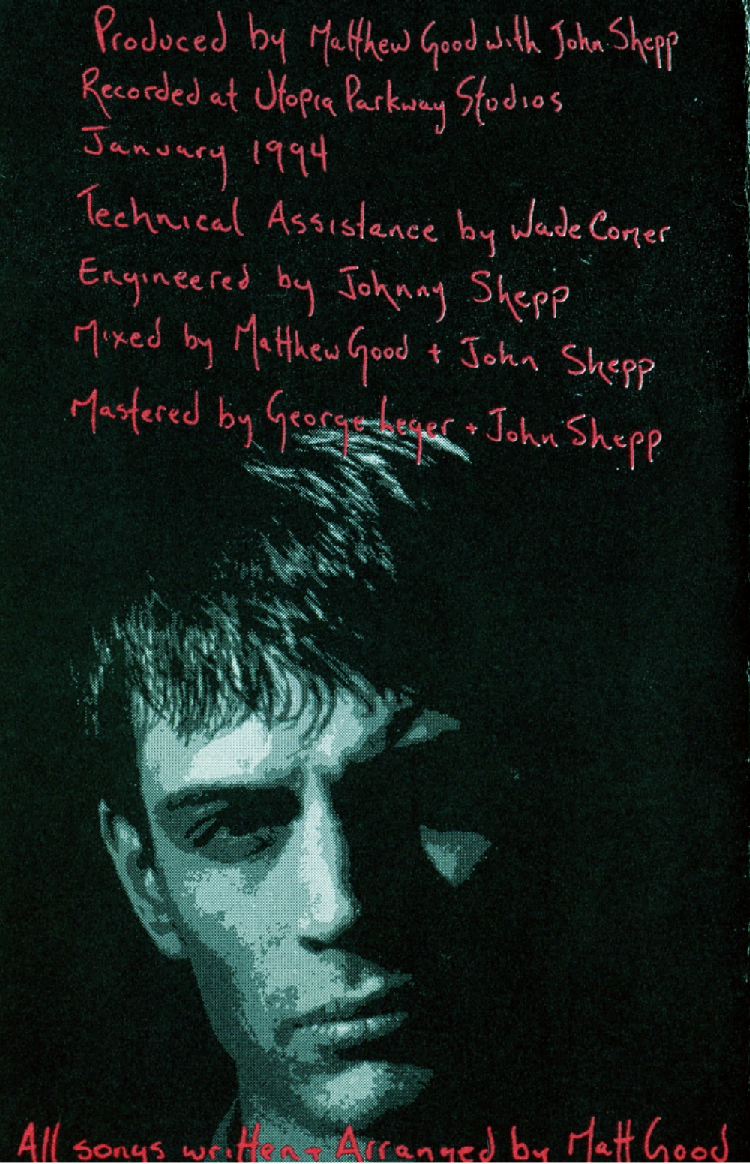
Hey Daniel, It's pretty much covered in the video. On my first meeting with Matt, I'm assuming it was with Danny, but I could be wrong, 25 years of doing records kinda makes it all fuzzy. However, shortly before that in my schedule, there was an entry in my schedule with Dan's name on it, so I can assume. SWN did some demos with me at Utopia in 1992 or 93, so they knew my place well. Timestamp Like I say, the band was well prepared, and things went down fast. I personally love what we did on that record, it was fully realized, niche though it was. CFOX ran the demo derby on Thursday nights I believe, it was a contest based on phone in responses I assume, we had that and mail then. The award is shown here: Timestamp Typically, Matt hated awards so he gave it me. Here's the credits on the sleeve. Written and arranged. by MG Credit for Euphony
-
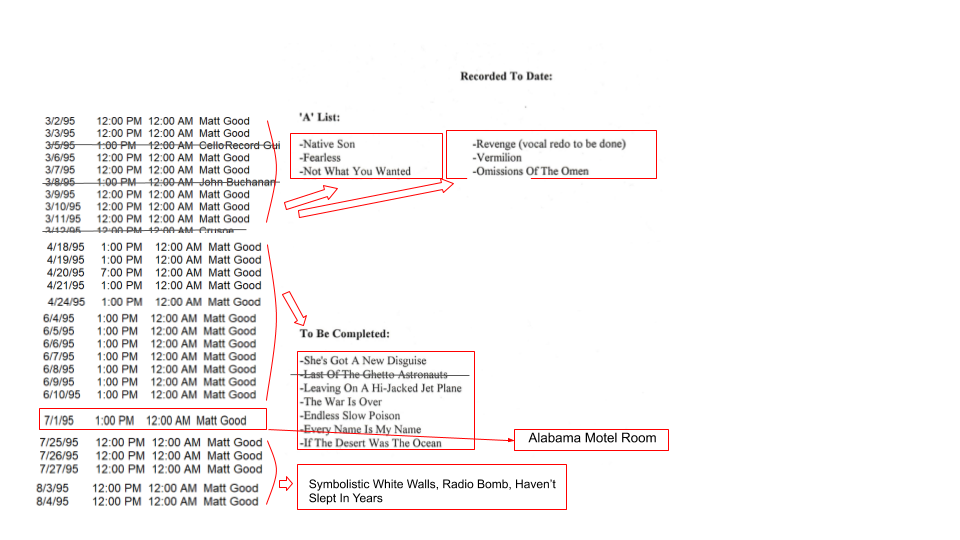
Utopia Parkway Studios closed it's doors in 2004 after 12 years in business. I had a tape and tracksheet vault in Studio B so it went home with me. You have to remember, it was 1995, and neither of us had internet. So we would talk on the phone, and notes would be made. Ideas would be floated. I was surprised to find the tracksheet for AMR because I assumed it went to Toronto, or L.A., but I must have dubbed the tapes and copied the tracksheet (just in case) and sent them. This is quite common. Pre the digital recording age, which started to become more predominant in the mid 1990's with the first ProTools DSP rigs, multi-track tapes would be copied from machine to machine, so in case the orginal master got degraded from use, they had the backup. In this case, using digital tape, it was just a matter of cloning from tape to tape. So Alabama Motel Room was a watershed song, and the songs that were born after it sealed the deal. You can note the sessions were like chunks of time, in which we'd start all over again, literally from the ground up, drum beds, bass, overdubs, mixing. That's why you'll notice a difference in tonality and production. The LOTGA songs are from destinct time periods: (See Graphic) The songs from the previous band lineup (Lost Album) were eventually all on the B list.